As you know, I like to inform you from time to time about digital accessibility. On the site, some notions have already been mentioned about the possibilities it could offer.
Although there are still some efforts to be made, the consortium working for accessible books has published an article demonstrating that progress has been made in the digital field.
You can read the article by clicking on this link.
On June 28, I attended a conference on thematic bibliographies around sport and comics.
Students had made particularly successful presentations, the videos are available on their channel.
The summary of this session can be found on this page of the Occitanie Livre website. I found the discussions very enriching.
As an author, I often ask myself questions about my job. How will it evolve? Am I taking a qualitative approach?
Of course, environmental issues arise in any field of activity. Although digital printing uses the least paper, it still consumes energy.
Authors have a far greater influence than they think on the solutions implemented in the book trade. For example, as was the case in the UK, they can put pressure on publishers to be more transparent about the origin of printed paper and the conditions of reforestation.
That said, it’s by reflecting too on the consequences of mass production in the artistic field that certain ideas for improvement are born. To limit an impact, some solutions are better suited than others. In my opinion, print-on-demand, which has been around for several years now, is a process that should be given greater consideration.
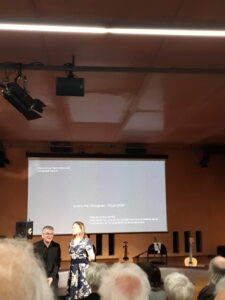
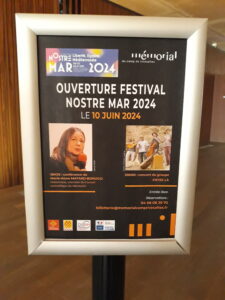
On June 10, the opening ceremony of the third edition of the Nostre Mar festival took place. A festival wishing to bring people together so as not to spread anti-LGBT hatred, racism and anti-semitism.
I listened to the first part devoted to a conference by the historian Marie-Anne Matard-Bonucci on the theme “fascism and anti-semitism” as well as the second part which was called “entre-là” and which was devoted to music.
It was an intense moment of reflection and exchange.
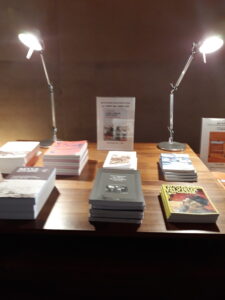
The memorial also has very interesting books.
Here are some photos from the evening:
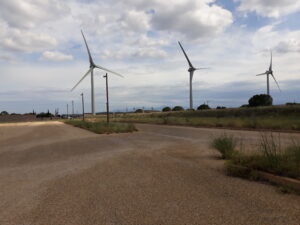
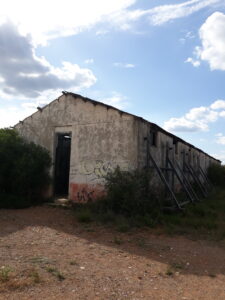
The wind turbines outside the Rivesaltes memorialOne of the camp barracks outside the memorialThe author at the memorial a little before the conferenceInside the auditorium, the historian and a member of the memorialOn this poster, two photos, one representing the speaker and the other the group in concert. The photo I wanted to post of the concert was blurry so I opted for an existing one.Library of memorial
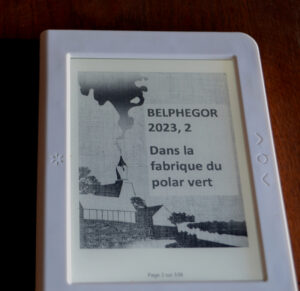
As part of the accessibility of digital books, the reading tool is very important. It must be adapted. Currently, very few e-reader models can both read text in audio and allow correct navigation. When I talk about navigation, I mean keys allowing you to move through the text and select actions indicated in the menu.
For my part, I tried a first model that was lent to me some time ago. He read the text of my book, which is quite astonishing and which, for people whose need arises, proves very useful function text to speech. Enlarging sans serif fonts is also an essential feature for reading digital books.
Currently I am working on several projects and actively preparing a professional book fair. In my journey, this led me to think about different subjects. In the field of science fiction, the literary form that we call dystopia is for many of us the opposite of utopia. And yet, utopia and dystopia have a form of complementarity. The themes they address are often very similar. For my part, I think that utopia and dystopia are interesting to explore. The two points that worry me on this subject are the dogmatism of the single thought that certain utopias would tend to present through the stories as well as the pessimism of the situations related in some of the dystopias
I really like Music, it accompanies me in professional life as well as in private life.
If I publish this post today it is also to talk about the importance I attach to listening to all styles of music, multicultural enrichment and meetings during festivals and concerts whatever they may be large or small sizes.
This weekend, I listened to the group Cuerteto Tafi as part of the Aspres spring festival. An event that I particularly like and for which I would like to post a link today so that you can discover a list of artists with open sounds and horizons.
“They can cut off all the flowers, they won’t stop spring.” an inspired quote from Pablo Neruda pronounced by the band during the concert
The meeting around the edition in large print took place online on Thursday, March 28, 2024 on the website of Occitanie book and reading. It is part of the reading for all. This event brought together several professionals around a theme related to the accessibility of the book.
I participated in this meeting which seem interesting for the artists here is a little report on this subject. The interventions of several participants including a visual disability awareness association and a specialized publishing house.
One of the most important information for reading adapted books concerns the font used, its size and the fact that it is necessarily without serif. The text needs to be formatted (paragraph, leading, etc.) too. A font has been developed following several studies, firefly is available on this website.
Tips
:
Avoid fonts with serif, that is to say with wheelbase, for reasons of accessibility.
Prefer a suitable size for reading or that can be enlarged with a support tool.
Regarding formatting air paragraphs with interlines.
Following the conference, a font that can be downloaded and used free of charge was proposed by a speaker: link to the website of this font.